


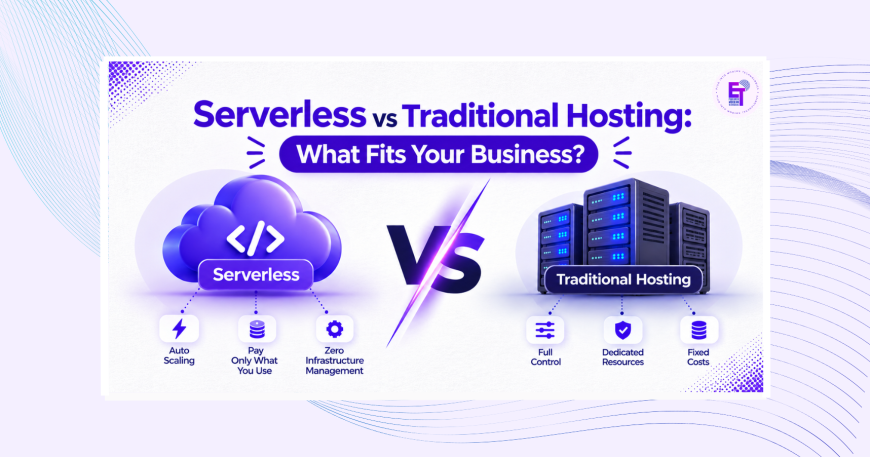
Choosing a hosting model feels harder than it should in 2026. The serverless vs traditional hosting debate gets pitched as a battle. In reality, it is a fit question. Your traffic pattern, budget, and technical support decide the right answer. This guide breaks both models down in plain language, no developer background required.
What Is Serverless Hosting?
Serverless hosting runs your website on infrastructure the provider manages entirely. You pay only for the compute time your site actually uses. There are no servers to patch, update, or monitor yourself.
What Is Traditional Hosting?
Traditional hosting means renting server capacity that stays active around the clock. You pay a fixed monthly fee no matter how much traffic arrives. This includes shared hosting, VPS plans, and dedicated servers.
Serverless vs Traditional Hosting: Quick Comparison
| Factor | Serverless | Traditional Hosting |
| Billing | Pay per execution | Fixed monthly cost |
| Best for | Spiky, unpredictable traffic | Steady, consistent traffic |
| Setup effort | Low, provider-managed | Higher, you manage the server |
| Speed after idle time | Cold start delay possible | Consistent, always running |
| Scaling | Automatic | Manual or pre-configured |
| Cost at high, steady traffic | Can rise quickly | Usually more predictable |
When Serverless Makes Sense for Your Website
A serverless hosting for small business setup shines under specific conditions. Consider it seriously if your site fits these patterns:
- Traffic spikes occasionally, like during a sale or launch
- Your site sees long stretches of low or no activity
- You lack an in-house developer to manage servers
- You are testing a new idea and want minimal upfront cost
The tradeoff worth knowing is cold start latency. If your site sits idle, the next visitor may wait briefly. The function simply needs a moment to wake up. For most business websites, this is barely noticeable.
When Traditional Hosting Makes Sense for Your Website
Traditional hosting still wins for businesses with steady, predictable visitor numbers. A traditional VPS hosting plan gives consistent performance without any wake-up delay. It fits well if:
- Your traffic stays fairly steady month to month
- You run background jobs, cron tasks, or a large database
- You want full control over server configuration
- Your monthly traffic pushes past a few million requests
At that volume, pay-per-execution pricing often costs more than a flat-rate server. This is exactly the tradeoff bigger platforms plan around from day one.
A Real Example Worth Knowing
Even large companies rethink serverless once traffic gets massive enough. Amazon’s own Prime Video engineering team faced this directly. Their monitoring service, built on serverless tools, hit scaling limits early. According to Prime Video’s own engineering write-up, the switch was dramatic. Moving that service to a traditional setup cut costs by 90 percent. This was not a rejection of serverless everywhere. It was a decision specific to one workload running at extremely high, constant volume.
The Hybrid Approach Many Businesses Use
You do not have to pick only one model for your entire site. Many businesses run their main website on traditional hosting for consistency. They then use serverless functions for tasks like contact forms, image processing, or scheduled reports. This split keeps your core site fast while still cutting costs on lighter, occasional workloads.
Quick Decision Guide
Choosing between serverless vs traditional hosting gets simpler once you know your real traffic pattern. Ask yourself these three questions before deciding:
- Is my traffic steady or unpredictable across the month?
- Do I have someone available to manage server updates?
- Am I running heavier background tasks, or mostly serving pages?
Steady traffic and background tasks usually point toward traditional hosting. Spiky, low-volume traffic usually points toward serverless.
Still unsure which model fits your business? The best hosting for business website review can settle it fast.
At Emmanuel Tech, we help businesses map real traffic against both models. We recommend a setup based on data, not trends.
Frequently Asked Questions
1. Is serverless cheaper than traditional hosting for a small business site?
Usually yes, since serverless hosting for small business sites fits light or irregular traffic well. Costs can rise once traffic becomes steady and high.
2. Does cold start latency actually affect visitors?
It can add a short delay after idle periods. Most business websites see minimal to no noticeable impact.
3. Can I switch hosting models later without rebuilding my site?
Often yes, especially for simpler websites. More complex applications may need some rework during the switch.
4. Is serverless hosting more secure than traditional hosting?
Not automatically. The provider secures the servers, but you still protect your code, access keys and data. Traditional hosting leaves more of the security work to you.
5. Which hosting is better for a business website with unpredictable traffic?
Serverless usually fits better. It scales up during spikes and down when traffic is quiet, so you only pay for what you use.
Your website does not need the trendiest infrastructure choice. The best hosting for business website 2026 choice is the one that fits real usage.

