


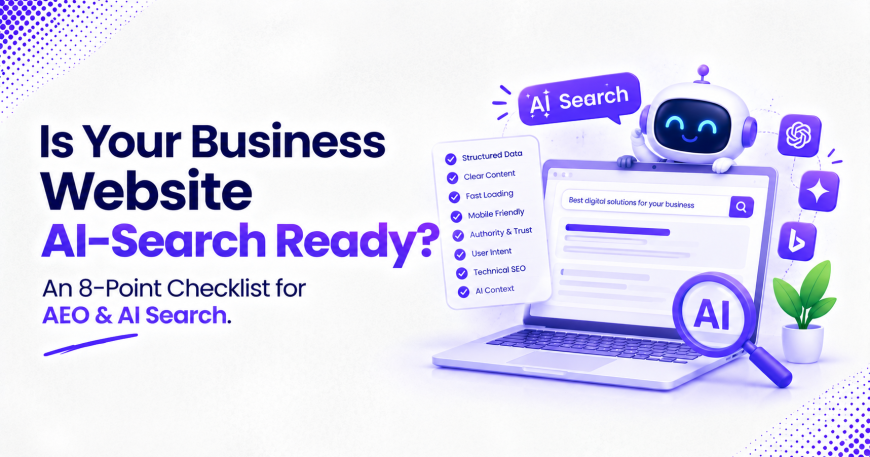
More buyers now ask ChatGPT and Perplexity for recommendations before they touch Google. A site built only for the old rules can quietly disappear from those answers. This AI search readiness checklist walks through eight checks any business owner can run today. No developer jargon, no guesswork, just a clear path to becoming AI-search ready.
What Does It Mean to Be AI-Search Ready?
AI-search ready means AI tools can find and read your site clearly. It also means they trust it enough to mention your business. This covers crawler access, content clarity, structured data, and consistent brand information. Miss enough of these signals, and AI engines quietly skip past your business.
8-Point Checklist for AEO & AI Search
1. AI crawlers can actually reach your site
Search bots are not the only visitors your site gets anymore. Tools like OpenAI’s GPTBot and similar AI crawlers now scan pages too. Many sites accidentally block these bots through old robots.txt rules. Check yours today and make sure AI crawlers like GPTBot are explicitly allowed.
2. Every key page answers one real question
AI engines reward pages that answer a question clearly and quickly. This is the foundation of a strong AEO checklist for business websites. Start each page with a short, direct answer in plain language. Save background details and elaboration for the paragraphs that follow.
3. Schema markup spells things out for machines
Structured data helps AI understand what a page actually contains. Add Organization, Article, and FAQPage schema to your key pages. This single step is one of the fastest ways to make your website AI-friendly. It also helps traditional Google search understand your content better.
4. Important details exist as text, not only images
A logo showing your certification looks great to a human visitor. An AI bot cannot read that badge unless it also appears as text. Rewrite key selling points, credentials, and service details in plain sentences. Do not let your best proof points live only inside a graphic.
5. Your brand reads the same everywhere online
AI tools cross-check your website against directories, social profiles, and reviews. This is where a solid AI search readiness checklist earns its keep. Mismatched descriptions across Google Business Profile, LinkedIn, and your homepage confuse these systems. Keep your name, services, and positioning identical across every platform.
6. Your site loads fast without hiding content in code
Most AI crawlers cannot run JavaScript the way a browser does. If your key content only loads after a script runs, it may never get seen. Ask your web team to confirm your pages render properly without JavaScript. A simple test is disabling JavaScript in your browser and reloading the page.
7. Your content actually gets updated
Stale pages send a weak signal to AI systems built to favor current information. Review your top pages every few months and refresh outdated stats or examples. This single habit supports real answer engine optimization for small business growth. Add a visible “last updated” date so AI tools and visitors trust what they read.
8. You know when AI tools are sending you traffic
Most businesses have no idea how many leads already start with an AI chatbot. Add “AI tool” to your contact form’s “how did you find us” list. Pair that with a basic GA4 filter for AI referral sources. This single change turns guesswork into a real, trackable channel.
Quick Recap: What to Check and Why It Matters
- Allow AI crawlers: No access means no visibility.
- Answer-first pages: AI extracts answers. It does not dig for them.
- Schema markup: It confirms what your page is about.
- Text over images: Bots cannot read visual badges.
- Consistent brand info: It builds trust across platforms.
- Fast, JS-light pages: Your content only counts if bots can actually see it.
- Regular content updates: Fresh pages signal relevance and accuracy.
- Track AI referrals: You turn guesses into real data
Most businesses fail two or three items on this AEO checklist for business websites. Fixing them does not require a full website rebuild. At Emmanuel Tech, we run this exact AI search readiness checklist for clients. We fix the gaps that matter most, and then move forward with all the necessary follow ups. If you’re business lacks AI search readiness, we are here, just a call away.
Frequently Asked Questions
1. Do small business websites really need to worry about AI search yet? Yes, buyer behavior is already shifting toward AI tools for research. Businesses that prepare now gain an early visibility advantage.
2. How is AEO different from regular SEO? Regular SEO targets clicks and rankings on a results page. AEO instead focuses on getting cited inside an AI-generated answer. A good AI search readiness checklist measures exactly this shift.
3. Can I fix AI search readiness myself, or do I need a developer? Several fixes, like schema and content rewrites, do not require a developer. Technical items like rendering and crawler access usually do.
Being AI-search ready is quickly becoming as important as being mobile-friendly once was.
Run through these eight checks and fix what you can. Small, steady changes are enough to make your website AI-friendly over time. Your business stays visible as search keeps changing.